
Overview
For most Canadian businesses, Canadian vs US hosting comes down to three questions: does a law or contract require your data to stay in Canada, where are your visitors, and who owns the data centre. PIPEDA, the federal private sector privacy law, does not require data to stay in Canada. Quebec’s Law 25 adds a written assessment before personal information leaves the province, and some public sector rules (Nova Scotia’s in particular) restrict storage outside Canada. If none of that applies to you, choose on speed, price and support.
This comparison is for small business owners, agencies and IT people choosing where to host a website, an online store or a business application. It covers the law in plain terms, the speed difference you’ll actually measure, and the mistakes that leave “Canadian hosting” holding data in the US anyway. It isn’t legal advice; for regulated data, check with your privacy lawyer or privacy officer.
Quick comparison
| Factor | Hosted in Canada | Hosted in the US |
|---|---|---|
| PIPEDA | Allowed | Allowed, with comparable protection by contract |
| Quebec Law 25 | Assessment needed if outside Quebec | Assessment and written agreement needed |
| Speed for Canadian visitors | Usually lowest latency | Fine near the border, slower further away |
| Speed for US visitors | Slightly slower | Lowest latency |
| Choice and price | Fewer providers | Widest choice |
| Client contracts | Meets “data in Canada” clauses | May not |
What Canadian privacy law actually requires
PIPEDA: no residency rule, but you stay responsible
PIPEDA applies to most private sector businesses outside Quebec, BC and Alberta (which have their own similar laws). The Privacy Commissioner’s guidelines on processing personal data across borders say plainly that PIPEDA doesn’t prohibit sending personal information to another country for processing. Two duties come with it:
- Accountability. You stay responsible for the data. Your contract with the host must give the information protection comparable to what it gets in Canada.
- Openness. Your privacy policy should tell people their information may be stored or processed outside Canada and may be accessible to that country’s courts and authorities.
In practice: US hosting is legal under PIPEDA, but your privacy policy needs that sentence, and your host’s terms should cover security and confidentiality.
Quebec Law 25: an assessment before data leaves Quebec
Since September 2023, a business covered by Quebec’s private sector law must assess the privacy risks before personal information is communicated outside Quebec, and that includes storing it with a host in Ontario or in the US. The assessment looks at how sensitive the data is, why it’s going there, the safeguards in place and the legal framework where it ends up. The transfer also needs a written agreement covering those safeguards.
So for a Quebec business, hosting in Montreal avoids the assessment, while hosting in Toronto and hosting in Virginia both trigger it. The US option makes the “legal framework” part of the assessment harder to write.
Public sector and their suppliers
Under Nova Scotia’s Personal Information International Disclosure Protection Act, public bodies and municipalities must keep personal information in Canada, accessed and disclosed only from Canada, with limited exceptions. The rule extends to service providers doing work for them. BC removed its strict residency rule for public bodies in 2021 and replaced it with assessment requirements for sensitive information going abroad. Health and education bodies in other provinces often have their own policies or contract clauses.
If you build websites or systems for hospitals, school boards, municipalities or government departments, read your contract. “Data must remain in Canada” clauses are common there, and they’re what makes Canadian hosting a requirement rather than a preference.
Who owns the data centre matters too
A server in a Toronto data centre run by a US-headquartered company can still be reached by US legal process. The US CLOUD Act (2018) lets US authorities require US providers to hand over data in their control regardless of where it’s stored. If your reason for hosting in Canada is to keep data out of foreign legal reach, ask both questions: where is the server, and where is the company that controls it?
Many contracts only ask for data stored in Canada, and a Canadian region of a US cloud provider meets that. Stricter ones ask for Canadian control as well. Know which you’re signing.
Speed: what the distance really costs
Latency follows distance. A visitor in Vancouver loading a site from a Vancouver or Seattle server sees a round trip of a few milliseconds; the same visitor loading from Toronto or the US East Coast sees several times that. Each page load needs several round trips (DNS, TCP, TLS, then the requests), so the gap adds up on the first visit.
Don’t guess. Measure from where your customers are:
ping -c 10 203.0.113.10
curl -o /dev/null -s -w 'connect %{time_connect}s  tls %{time_appconnect}s  first byte %{time_starttransfer}s\n' https://example.com/
Run it against a test server or demo site in each location you’re considering. If most visitors are in one region, host close to them. If they’re spread across Canada and the US, the server location matters less than caching and a CDN for images and static files.
The data people forget about
Moving the website to Canada doesn’t move everything. Check where these live before you promise a client “all data in Canada”:
- Backups. Off-site backups often go to a different region or provider than the server.
- Email. If mail runs on Microsoft 365 or Google Workspace, its location is set in that account, not by your web host.
- Form and payment data. Contact form plugins that send entries to a third-party service, and payment processors, store data on their own systems.
- CDN and security proxies. They cache pages and see visitors’ IP addresses in many countries. That’s usually fine, but it belongs in your privacy policy.
- Analytics. Visitor data in an analytics service sits wherever that service keeps it.
Which one should you choose?
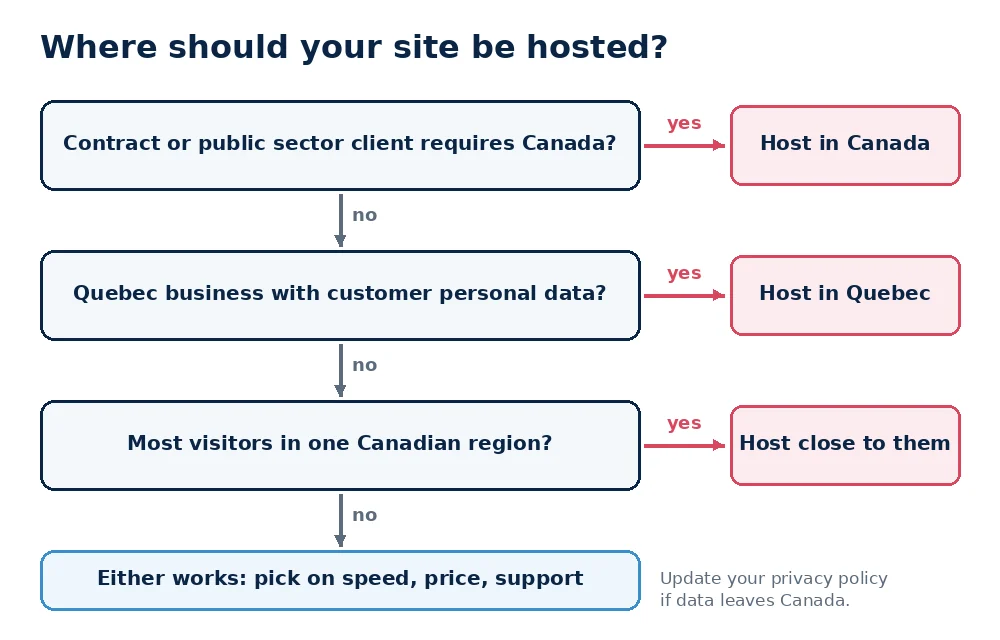
- Choose Canadian hosting if a contract or public sector client requires data in Canada, if you’re a Quebec business handling customer data and want to avoid a transfer assessment, or if your visitors are mainly in one Canadian region and you want the lowest latency for them.
- US hosting is fine if PIPEDA is the only law that applies, your privacy policy says data may be stored outside Canada, and your audience is mostly American or spread across North America.
- Either way, ask the host which data centre your server will sit in, where backups are stored and who owns the facility, and get the answers in writing for regulated projects.
For provider checklists, see choosing a VPS provider in Canada and Canadian shared hosting. If you need a server you control end to end, compare VPS and dedicated servers, then look at our VPS plans and ask us which location suits your data.
Frequently Asked Questions
Does PIPEDA require data to be stored in Canada?
No. PIPEDA allows businesses to store and process personal information outside Canada. You stay accountable for it, must protect it by contract, and should tell people in your privacy policy that it may be held in another country.
Can a Quebec business host its website in the US?
Yes, but Law 25 requires a privacy assessment before personal information leaves Quebec and a written agreement with the provider. The same applies to hosting in another Canadian province.
Is my data safe from US law if it’s hosted in Canada?
Not always. If the provider is a US company, the US CLOUD Act can require it to hand over data it controls even when the server is in Canada. A Canadian-owned provider with Canadian data centres avoids that.
Is Canadian hosting faster than US hosting?
For visitors in Canada it’s usually faster, because the server is closer. For a mostly American audience a US server is faster. Measure from your visitors’ locations rather than assuming.
Do I need to mention hosting location in my privacy policy?
If personal information may be stored or processed outside Canada, the Privacy Commissioner expects you to say so and to mention that it may be accessible to foreign courts and authorities.